Saturday, March 17, 2012
No Shmoz?
The only collection of "The Squirrel Cage" that I'm aware has ever been published is an independently produced collection of strips from 1937, which was until recently available from Ken Pierce Books. Unfortunately, it's now showing as "out of stock" - which I wouldn't take as a good sign. You may wish to check back, however. Here's the link to the listing. It's a nice little volume with 30 Sunday strips reproduced in color, although there's no annotation at all.

Thursday, March 8, 2012
Pun Puzzle Example, and How to Get The Little Hitchhiker Out of Your House.
For at least a few months in 1940 Ahern experimented with pun puzzles. Here's an example.


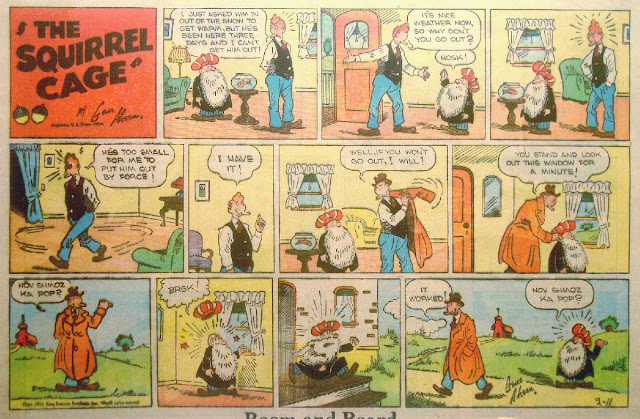

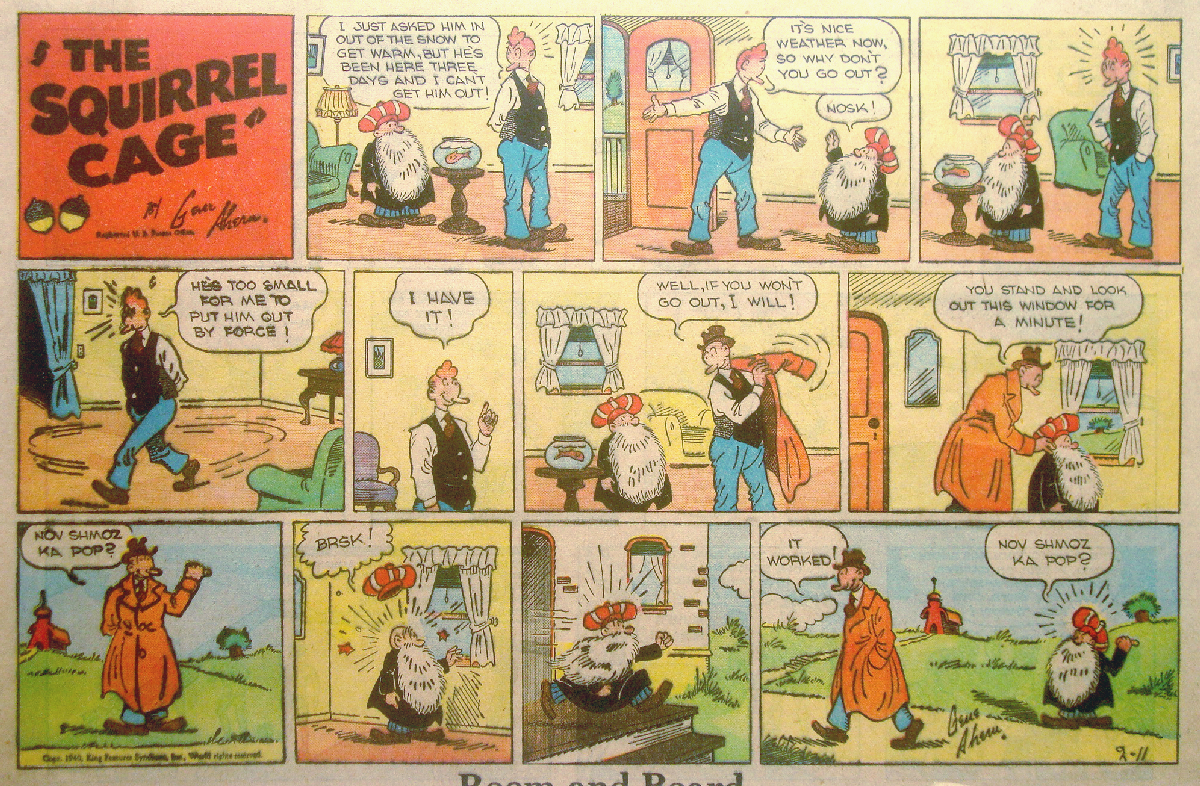
Either he got tired of them, or he realized they just weren't as funny as some of the other stuff he had already been doing. He soon dropped this formula & went back to focusing the hitchhiker. Here's another great mini-continuity, where the hitchhiker gets invited inside - but then won't leave. I love the strategy for removing him - perfect!

Before the Cage, There Was Food.
Here are some examples of Ahern's early work, before he started Our Boarding House. The first is a panel from August 22, 1916, that I think shows some surrealist leanings.

Ahern was clearly influenced by Rube Goldberg, and many of his early strips use Goldbergian formulas, including crazy inventions. There's more here, though - look at the building in the lower right corner. It looks like something from Dr. Suess! Such buildings would often appear in the Nut Bros. and later in The Squirrel Cage.
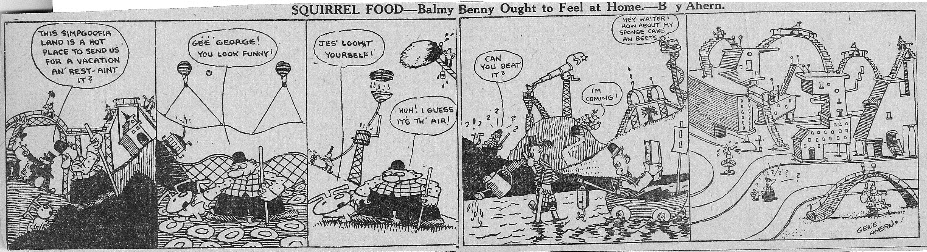
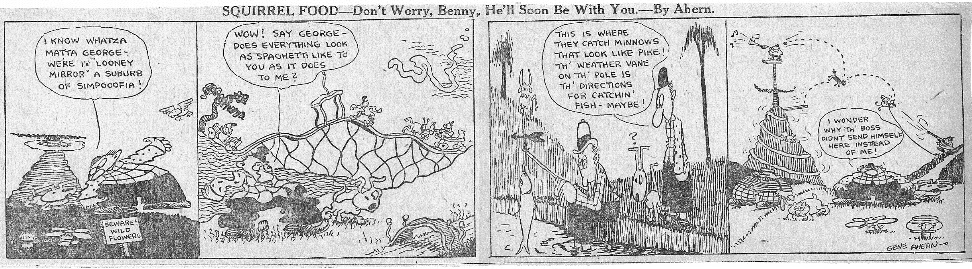
Here's an even better example of surrealism, from Ahern's "Squirrel Food" strip, which featured one of his first regular characters, Balmy Benny. These are dated Sep. 15, 17, and 18, 1917. The boss gives Benny a vacation in Simpgoofia.


Ahern was clearly influenced by Rube Goldberg, and many of his early strips use Goldbergian formulas, including crazy inventions. There's more here, though - look at the building in the lower right corner. It looks like something from Dr. Suess! Such buildings would often appear in the Nut Bros. and later in The Squirrel Cage.
Here's an even better example of surrealism, from Ahern's "Squirrel Food" strip, which featured one of his first regular characters, Balmy Benny. These are dated Sep. 15, 17, and 18, 1917. The boss gives Benny a vacation in Simpgoofia.
Sunday, March 4, 2012
Nov Blog Ka-Pop?
Be sure to check out Paul Tumey's Screwball Comics blog for more great Squirrel Cage strips, as well as other screwball wonderments!
Early Continuity
Ahern played with continuity in "The Squirrel Cage" from the early years. We've seen some examples from 1937 with the annoying neighbor. In 1938 there was a fairly long sleepwalking sequence (two examples below).


However, this was not really continuity of story, but of theme. The first real continuing story that I've found comes in 1939, when Merlin the Magician is introduced (who will, of course, help our friends get rid of that "annoying pest"). However, The Little Hitchhiker gets hold of Merlin's wand. This story lasts for several months, with the magician always failing to get the wand. Here are some examples, including the strip where Merlin loses the wand:


I don't have the finale, so I'm not sure how this story ends, but by 1940 we're back to more stand-alone strips. Ahern experiments with some word puzzle / pun strips, which are clever, but not really that funny. Maybe someone tells him they're not so great, or maybe he just realizes it himself, and he returns to the old formula. But by 1942 he would introduce a new and very different character that would lead the strip into fantastic adventures...!
Saturday, February 4, 2012
Go Away
Probably the best remembered theme of "The Squirrel Cage" was that the other unnamed players were often trying to get The Little Hitchhiker to go away. There are probably hundreds of strips built around this, often ending with our bearded friend somehow benefitting from any attempts to remove him. This was something Ahern had first played with in "The Squirrel Cage" in 1937, but with an unwanted neighbor as the target. Here are a few examples:


Although Ahern soon did away with this character, he realized that the theme was a good one. It would not be long before The Little Hitchhiker became the eyesore of our two "normal" friends. Here are some examples from the early 1940s based on getting rid of The Little Hitchhiker.


Although Ahern soon did away with this character, he realized that the theme was a good one. It would not be long before The Little Hitchhiker became the eyesore of our two "normal" friends. Here are some examples from the early 1940s based on getting rid of The Little Hitchhiker.


Thursday, February 2, 2012
Evolution of a Hitchhiker
The Little Hitchhiker is really the only character people remember from "The Squirrel Cage," but he was not there at the start. Here is the very first Sunday from June 21, 1936.

At first, the feature was not really so different from Ahern's old topper "The Nut Bros." which was featured with "Our Boarding House." However, "The Squirrel Cage" was designed as a longer feature, and so Ahern found he could develop a story. "The Nut Bros." was never longer than a couple of panels, and so it was never more than a vignette of vaudeville-type screwball jokes and puns. Here are a two examples of "The Nut Bros." published shortly before Ahern moved to King Features and started "The Squirrel Cage."
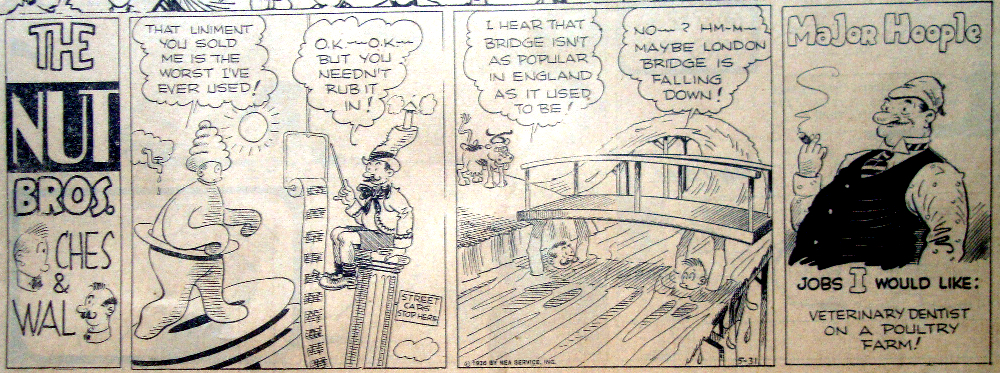

The Nut Bros. themselves seem indistinguishable from the unnamed players in "The Squirrel Cage," and the surreal visual elements in the strip would manifest, as well.
As for the hitchhiker, we'll now look at all of the precursors, leading up to (and including) the first utterance of the immortal phrase, "Nov Shmoz Ka Pop?" We start with August 9, 1936, where we see our Nuttish friend with his thumb out in the last panel.

The next hitchhiker we see is an actual precursor, rather than a suggestion. This strip dates from November 1, 1936:

And a close-up look at the traveler:

The next instance is two weeks later, on Nov. 15, 1936:
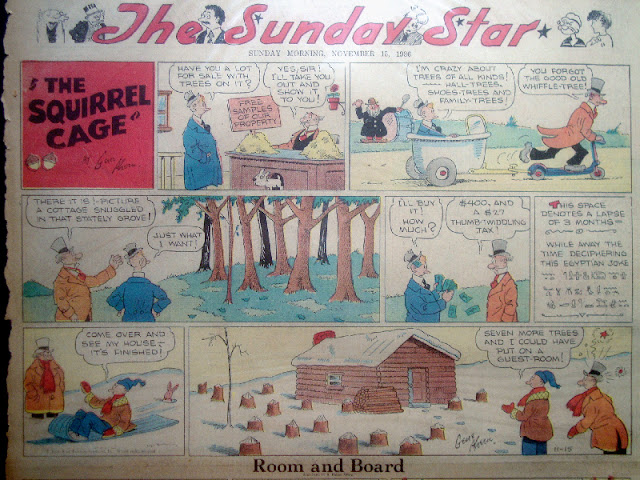
And again, a close-up:

The following week, November 22, 1936:

And a close-up reveals some important changes:

The mysterious fur hat gives him less the appearance of a typical American hobo, as he had seemed thus far, and more that of someone displaced from somewhere in Eastern Europe. Two weeks later, however, we're back to the hobo. This is from December 6, 1936:

And a close-up:

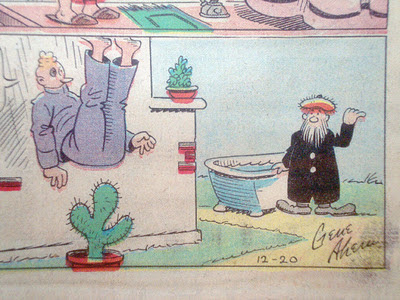
On December 20, 1936, We're back to the foreigner:

And a close-up:
And finally, on December 27, 1936, The Little Hitchhiker is born!

And his first utterance will remain his most memorable.


At first, the feature was not really so different from Ahern's old topper "The Nut Bros." which was featured with "Our Boarding House." However, "The Squirrel Cage" was designed as a longer feature, and so Ahern found he could develop a story. "The Nut Bros." was never longer than a couple of panels, and so it was never more than a vignette of vaudeville-type screwball jokes and puns. Here are a two examples of "The Nut Bros." published shortly before Ahern moved to King Features and started "The Squirrel Cage."
The Nut Bros. themselves seem indistinguishable from the unnamed players in "The Squirrel Cage," and the surreal visual elements in the strip would manifest, as well.
As for the hitchhiker, we'll now look at all of the precursors, leading up to (and including) the first utterance of the immortal phrase, "Nov Shmoz Ka Pop?" We start with August 9, 1936, where we see our Nuttish friend with his thumb out in the last panel.

The next hitchhiker we see is an actual precursor, rather than a suggestion. This strip dates from November 1, 1936:

And a close-up look at the traveler:

The next instance is two weeks later, on Nov. 15, 1936:

And again, a close-up:

The following week, November 22, 1936:

And a close-up reveals some important changes:

The mysterious fur hat gives him less the appearance of a typical American hobo, as he had seemed thus far, and more that of someone displaced from somewhere in Eastern Europe. Two weeks later, however, we're back to the hobo. This is from December 6, 1936:

And a close-up:

On December 20, 1936, We're back to the foreigner:

And a close-up:

And finally, on December 27, 1936, The Little Hitchhiker is born!

And his first utterance will remain his most memorable.

Subscribe to:
Posts (Atom)